Friday, 24 June 2011

Fielders

Fielding (cricket)

From Wikipedia, the free encyclopedia
A wicket-keeper (bending down) and three slips wait for the next ball. The batsman - out of shot - is a left-hander
Fielding in the sport of cricket is the action of fielders in collecting the ball after it is struck by the batsman, in such a way as to either limit the number of runs that the batsman scores or get the batsman out by catching the ball in flight or running the batsman out. A fielder or fieldsman may field the ball with any part of his person. However, if while the ball is in play he wilfully fields it otherwise (e.g. by using his hat), the ball becomes dead and 5 penalty runs are awarded to the batting side unless the ball previously struck a batsman not attempting to hit or avoid the ball. Most of the rules covering fielders are in Law 41 of the Laws of cricket.
In the early days of Test cricket, fielding was not a priority and many players were sloppy when it came to fielding.[citation needed] With the advent of One Day International matches, fielding became more professional as saving runs became more important. A good fielding side can often save 30+ runs in the course of an ODI innings.[citation needed]

Contents

[hide]

[edit] Fielding position names and locations

Fielding positions
Since there are only 11 players on a team, one of whom is the bowler, and usually another as the wicket-keeper, at most nine other fielding positions can be used at any given time. Which positions are filled by players and which remain vacant is a tactical decision made by the captain of the fielding team. The captain (usually in consultation with the bowler and sometimes other members of the team) may move players between fielding positions at any time except when a bowler is in the act of bowling to a batsman.
There are a number of named basic fielding positions, some of which are employed very commonly and others that are used less often. However, fielding positions are not fixed, and fielders can be placed in positions that differ from the basic positions. Most of the positions are named roughly according to a system of polar coordinates - one word (leg, cover, mid-wicket) specifies the angle from the batsman, and is optionally preceded by an adjective describing the distance from the batsman (silly, short, deep or long). Words such as "backward", "forward", or "square" can further indicate the angle.
The image shows the location of most of the named fielding positions. This image assumes the batsman is right-handed. The area to the left of a right-handed batsman (from the batsman's point of view) is called the leg side or on side, while that to the right is the off side. If the batsman is left-handed, the leg and off sides are reversed and the fielding positions are a mirror image of those shown.

[edit] Catching positions

Some fielding positions are used offensively. That is, players are put there with the main aim being to catch out the batsman rather than to stop or slow down the scoring of runs. These positions include Slip (often there are multiple slips next to each other, designated First slip, Second slip, Third slip, etc., numbered outwards from the wicket-keeper) meant to catch balls that just edge off the bat; Fly slip; Gully; Leg slip; Leg gully; the short and silly positions. Bat pad is a position specifically intended to catch balls that unintentionally strike the bat and leg pad, and thus end up only a metre or two to the leg side

[edit] Other positions

Other positions worth noting include:
  • Wicket-keeper
  • Long stop, who stands behind the wicket-keeper towards the boundary (usually when a wicket-keeper is believed to be inept and almost never seen in professional cricket). This position is sometimes euphemistically referred to as very fine leg.[1]
  • Sweeper, an alternative name for deep cover, deep extra cover or deep midwicket (that is, near the boundary on the off side or the on side), usually defensive and intended to prevent a four being scored.
  • Cow corner, an informal jocular term for the position on the boundary between deep midwicket and long on.
  • 45 on the 1. A position on the leg side 45° behind square, defending the single. An alternative description for backward short leg.
Also the bowler, after delivering the ball, must avoid running on the pitch so usually ends up fielding near silly mid on or silly mid off, but somewhat closer to the pitch.

[edit] Modifiers

Alastair Cook of the England cricket team standing in a catching stance typical of a fieldsman in a silly catching position
Deep, long 
Farther away from the batsman.
Short 
Closer to the batsman.
Silly 
Very close to the batsman.
Square 
Somewhere along an imaginary extension of the popping crease.
Fine 
Closer to an extension of an imaginary line along the middle of the pitch bisecting the stumps, when describing a fielder behind square.
Straight 
Closer to an extension of an imaginary line along the middle of the pitch bisecting the stumps, when describing a fielder in front of square.
Wide 
Further from an extension of an imaginary line along the middle of the pitch bisecting the stumps.
Forward 
In front of square; further towards the end occupied by the bowler and further away from the end occupied by the batsman on strike.
Backward 
Behind square; further towards the end occupied by the batsman on strike and further away from the end occupied by the bowler.
Additionally, commentators or spectators discussing the details of field placement will often use descriptive phrases such as "gully is a bit wider than normal" or "mid off is standing too deep, he should come in shorter".

[edit] Restrictions on field placement

Fielders may be placed anywhere on the field, subject to the following rules. At the time the ball is bowled:
  • No fielder may be standing on or with any part of his body over the pitch (the central strip of the playing area between the wickets). If his body casts a shadow over the pitch the shadow must not move until after the batsman has played (or had the opportunity to play) at the ball.
  • There may be no more than two fielders, other than possibly the wicket-keeper, standing in the quadrant of the field behind square leg. See Bodyline for details on one reason this rule exists.
  • In some one-day matches:
    • During designated overs of an innings (see Powerplay (cricket)), there may be no more than two fielders standing outside an oval line marked on the field, being semicircles centred on the middle stump of each wicket of radius 30 yards, joined by straight lines parallel to the pitch. This is known as the fielding circle. In addition, during these overs there must be two fielders (other than the wicket-keeper) in designated "close catching" positions.
    • For the remainder of the innings there may be no more than five fielders standing outside the fielding circle.
    • In addition no fielder may stand behind directly behind the wicketkeeper. Fielders may be placed anywhere on the field other than the pitch or behind the wicketkeeper.
The restriction for one-day cricket is designed to prevent the fielding team from setting extremely defensive fields and concentrating solely on preventing the batting team from scoring runs, which many consider leads to boring play.
If any of these rules is violated, an umpire will call the delivery a no ball. Additionally a player may not make any significant movement after the ball comes into play and before the ball reaches the striker. If this happens, an umpire will call and signal 'dead ball'. For close fielders anything other than minor adjustments to stance or position in relation to the striker is significant. In the outfield, fielders may move in towards the striker or striker's wicket; indeed, they usually do. However, anything other than slight movement off line or away from the striker is to be considered significant.


Wickets

Wicket

From Wikipedia, the free encyclopedia
In the sport of cricket the word wicket has several distinct meanings:

Contents

[hide]

[edit] Definitions of wicket

Each wicket consists of three stumps, upright wooden poles that are hammered into the ground, topped with two wooden crosspieces, known as the bails.
Most of the time, the wicket is one of the two sets of three stumps and two bails at either end of the pitch.[1] The wicket is guarded by a batsman who, with his bat, attempts to prevent the ball from hitting the wicket.
The origin of the word is from the standard definition of wicket as a small gate. Historically, cricket wickets had only two stumps and one bail and looked like a gate. The third (middle) stump was introduced in 1775.
The size and shape of the wicket has changed several times during the last 300 years and its dimensions and placing is now determined by Law 8 in the Laws of Cricket, thus:
  • Law 8: The wickets. The wicket consists of three wooden stumps that are 28 inches (71 cm) tall. The stumps are placed along the batting crease with equal distances between each stump. They are positioned so they are 9 inches (23 cm) wide. Two wooden bails are placed on top of the stumps. The bails must not project more than 0.5 inches (1.3 cm) above the stumps, and must, for men's cricket, be 45⁄16 inches (10.95 cm) long. There are also specified lengths for the barrel and spigots of the bail. There are different specifications for the wickets and bails for junior cricket. The umpires may dispense with the bails if conditions are unfit (e.g., if it is windy they might fall off by themselves). Further details on the specifications of the wickets are contained in Appendix A to the laws.

[edit] Dismissing a batsman

Wicket also refers to the event of a batsman getting out. The batsman is said to have lost his wicket. If dismissed by a bowler, the bowler is said to have taken his wicket. The number of wickets taken is the primary measure of a bowler's ability.
For a batsman to be dismissed by being bowled, run out, stumped or hit wicket, his wicket needs to be put down. What this means is defined by Law 28 of the Laws of cricket. The wicket is put down if a bail is completely removed from the top of the stumps, or a stump is struck out of the ground by the ball, the striker's bat, the striker's person (or by any part of his clothing or equipment becoming detached from his person), a fielder (with his hand or arm, and provided that the ball is held in the hand or hands so used, or in the hand of the arm so used). The wicket is also put down if a fielder pulls a stump out of the ground in the same manner.
If one bail is off, removing the remaining bail or striking or pulling any of the three stumps out of the ground is sufficient to put the wicket down. A fielder may remake the wicket, if necessary, in order to put it down to have an opportunity of running out a batsman.
If however both bails are off, a fielder must remove one of the three stumps out of the ground with the ball, or pull it out of the ground with a hand or arm, provided that the ball is held in the hand or hands so used, or in the hand of the arm so used.
If the umpires have agreed to dispense with bails, because, for example, it is too windy for the bails to remain on the stumps, the decision as to whether the wicket has been put down is one for the umpire concerned to decide. After a decision to play without bails, the wicket has been put down if the umpire concerned is satisfied that the wicket has been struck by the ball, by the striker's bat, person, or items of his clothing or equipment separated from his person as described above, or by a fielder with the hand holding the ball or with the arm of the hand holding the ball.

[edit] Partnership

The sequence of time over which two particular batsmen bat together, a partnership, is referred to as a specifically numbered wicket when discriminating it from other partnerships in the innings.
  • The first wicket partnership is from the start of the innings until one of the first two batsmen gets out.
  • The second wicket partnership is from when the third batsman gets in until a second batsman gets out.
  • etc...
  • The tenth wicket or last wicket partnership is from when the eleventh (last) batsman gets in until a tenth (last) batsman gets out.

[edit] Winning by number of wickets

A team can win a match by a certain number of wickets. This means that they were batting last, and reached the winning target with a certain number of batsmen still not dismissed. A team's innings ends when ten batsmen are dismissed, so, for example, if the side scored the required number of runs to win with only three batsmen dismissed, they are said to have won by seven wickets.

[edit] The pitch

The word wicket is also sometimes used to refer to the cricket pitch itself. According to the Laws of Cricket, this usage is incorrect, but it is in common usage and commonly understood by cricket followers. This usage probably derives from the days when the outfield was kept short by grazing sheep on it and the playing surface, which was specially prepared, was protected from them by a light wicker fence around it. Since many regular grounds had resident bat-makers it is quite possible that the branches cut off from the willow wood used for the bats formed all or part of this fence.[citation needed]
The term sticky wicket refers to a situation in which the pitch has become damp, typically due to rain or high humidity. This makes the path of the ball more unpredictable thus making the job of defending the stumps that much more difficult. The full phrase is thought to have originally been "to bat on a sticky wicket." Such pitches were commonplace at all levels of the game (i.e. up to Test Match level) until the late 1950s.

catches

Caught

From Wikipedia, the free encyclopedia
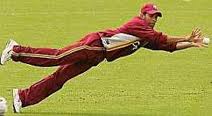
An Australian fielder runs to take a catch
New Zealand fast bowler Shane Bond about to take Mohammad Yousuf caught and bowled
Caught is a method of dismissing a batsman in the sport of cricket. Being caught out is the most common method of dismissal at higher levels of competition. This method of dismissal is covered by Law 32 of the Laws of cricket which reads:[1]
A batsman is out caught if a fielder catches the ball fully within the field of play without it bouncing once the ball has touched the striker's bat or glove holding the bat. If a batsman could be given out caught or by any other method except bowled, 'caught' takes precedence.
This means that the batsman cannot be out caught if:
  • The ball is called a no ball or dead ball.
  • The batsman does not hit the ball with his bat or the gloved hand holding the bat.
  • The ball, having been hit, makes contact with the field before a fielder catches the ball.
  • The ball does not remain under the control of the fielder.
  • The ball is hit and lands beyond the boundary; (six runs).
  • A fielder taking the catch makes contact with the boundary rope or the area outside the boundary.
  • The ball hits a close in fielder on the helmet, and rebounds in the air for a catch.
If a batsman is out caught, any runs scored off that delivery are voided. If the catch is taken by the wicket-keeper, then informally it is known as a "caught behind". A catch by the bowler is known as a "caught and bowled" (this has nothing to do with the dismissal bowled), and is usually annotated on a scorecard as c. and b. or c&b followed by the bowler's name.
If the catch taken is pronounced or obvious, the players need not appeal to the umpire; the batsman normally chooses to acknowledge the dismissal himself. However, in the event that the ball brushes the edge of the bat, or the catch is taken very close to the ground, or the ball appears to have bounced off the batsman's foot (so it has not touched the ground), or the ball appearing to come off the bat very close to the pitch surface (bump ball), or if the batsman is reluctant to accept that he has been dismissed, the fielding team has to appeal to the umpire for this decision.
If a batsman is caught, the bowler is credited with the batsman's wicket and the catching fielder is credited for the dismissal. If the two batsmen cross each other, in attempting to take a run, before the catch was taken, the new incoming batsman becomes the non-striker with the exception being when the wicket falling in the last ball of an over, when if the batsmen cross the new batsman will be on strike.

Bowling

Bowling (cricket)

From Wikipedia, the free encyclopedia
This is bowling.OGG
The basics of bowling.
Darren Gough bowling
In the sport of cricket, bowling is the action of propelling the ball toward the wicket defended by a batsman. A player skilled at bowling is called a bowler. Bowling the ball is distinguished from simply throwing the ball by a strictly specified biomechanical definition which restricts the angle of extension of the elbow.
There are different types of bowlers ranging from fast bowlers, whose primary weapon is pace, through swing and seam bowlers who try to make the ball deviate in its course through the air or when it bounces, to slow bowlers, who will attempt to deceive the batsmen with a variety of flight and spin. A single act of bowling the ball towards the batsman is called a ball or a delivery. Bowlers bowl deliveries in sets of six, called an over. Once a bowler has bowled their over, one of their team mates will bowl an over from the other end of the pitch.
The Laws of Cricket govern how a ball must be bowled.[1] If a ball is bowled illegally, an umpire will rule it a no ball.[2] If a ball is bowled too wide of the stumps or too high for the batsman to be able to hit it, an umpire will rule it a wide.[3]

Contents

[hide]

[edit] History of bowling


Bowling techniques
Deliveries
Historical Styles
This box: view · talk · edit
In the early days of cricketing history, underarm bowling was the only method employed. Many theories exist about the origins of cricket. One suggests that the game began among shepherds hitting a stone or a ball of wool with their crooks and, at the same time, defending the wicket gate into the sheep-fold (from Anglo Saxon 'cricce', a crooked staff). A second theory suggests the name came from a low stool known as a 'cricket' in England, which from the side looked like the long, low wicket used in the early days of the game (originally from the Flemish 'krickstoel', a low stool on which parishioners knelt in church). There is also a reference to 'criquet' in North-East France in 1478 and evidence that the game evolved in South-East England in the Middle Ages.
In 1706 William Goldwyn published the first description of the game. He wrote that two teams were first seen carrying their curving bats to the venue, choosing a pitch and arguing over the rules to be played. They pitched two sets of wickets, each with a "milk-white" bail perched on two stumps; toss a coin for first knock, the umpire called "play" and the "leathern orb" was bowled. They had four-ball overs, the umpires leant on their staves (which the batters had to touch to complete a run), and the scorers sat on a mound making notches.
The first written "Laws of Cricket" were drawn up in 1744. They stated, "the principals shall choose from amongst the gentlemen present two umpires who shall absolutely decide all disputes. The stumps must be 22 inches high and the bail across them six inches. The ball must be between 5 & 6 ounces, and the two sets of stumps 22 yards apart". There were no limits on the shape or size of the bat. It appears that 40 notches was viewed as a very big score, probably due to the bowlers bowling quickly at shins unprotected by pads. The world's first cricket club was formed in Hambledon in the 1760s and the Marylebone Cricket Club (MCC) was founded in 1787.
During the 1760s and 1770s it became common to pitch the ball through the air, rather than roll it along the ground. This innovation gave bowlers the weapons of length, deception through the air, plus increased pace. It also opened new possibilities for spin and swerve. In response, batters had to master timing and shot selection. One immediate consequence was the replacement of the curving bat with the straight one. All of this raised the premium on skill and lessened the influence of rough ground and brute force. It was in the 1770s that the modern game began to take shape. The weight of the ball was limited to between five and a half and five and three-quarter ounces, and the width of the bat to four inches. The latter ruling followed an innings by a batter called "Shock" White, who appeared with a bat the width of the wicket. In 1774, the first leg before law was published. Also around this time, a third stump became commonplace. By 1780, three days had become the duration of a major match, and this year also saw the creation of the first six-seam cricket ball. In 1788, the MCC published its first revision of the laws, which prohibited charging down an opponent and also provided for mowing and covering the wicket in order to standardise conditions. The desire for standardisation reflected the massive increase in the popularity of cricket during the 18th Century. Between 1730 & 1740, 150 cricket matches were recorded in the papers of the time. Between 1750 & 1760, this figure rose to 230, and between 1770 & 1790 over 500.
The 19th Century saw a series of significant changes. Wide deliveries were outlawed in 1811. The circumference of the ball was specified for the first time in 1838 (its weight had been dictated 60 years earlier). Pads, made of cork, became available for the first time in 1841, and these were further developed following the invention of vulcanised rubber, which was also used to introduce protective gloves in 1848. In the 1870s, boundaries were introduced - previously, all hits had to be run; if the ball went into the crowd, the spectators would clear a way for the fieldsman to fetch it. The biggest change, however, was in how the ball was delivered by the bowler.
At the start of the century, all bowlers were still delivering the ball under-arm. However, so the story goes, John Willes became the first bowler to use a "round-arm" technique after practising with his sister Christina, who had used the technique, as she was unable to bowl underarm due to her wide dress impeding her delivery of the ball.[4]
Soon after this action was to be employed more in matches, however, the roundarm method was quickly banned and determined to be illegal by the MCC stating "the ball must be delivered underhand, not thrown or jerked, with the hand underneath the elbow at the time of delivering the ball".[5] When it was accepted the rules stated that the arm could not be raised above the shoulder. It was quickly found, however, that a raised arm imparted more accuracy and generated more bounce than the roundarm method. Again, the governing body banned the method. It was not until the method was finally accepted by the MCC in 1835[6] that it grew rapidly in popularity amongst all players. Underarm bowling hitherto had almost disappeared from the game.

[edit] Modern day underarm bowling

An infamous "underarm bowling incident" occurred during a match in 1981, in which the Australian bowler, Trevor Chappell, took advantage of the fact that underarm bowling was still legal by rolling the ball along the ground. By doing so he avoided the possibility that the New Zealand batsman, Brian McKechnie, would score a six from the last ball to tie the match, as the bat would not be able to hit the ball high enough to score a six.[7]
As a result of this incident underarm bowling was subsequently made illegal in all grades of cricket, except by prior agreement of both teams, as it was not considered to be within the spirit of the game.

[edit] The bowling action

Philadelphian cricketer Bart King bowling
Bowling the ball is distinguished from simply throwing the ball by a strictly specified biomechanical definition.
Originally, this definition said that the elbow joint must not straighten out during the bowling action. Bowlers generally hold their elbows fully extended and rotate the arm vertically about the shoulder joint to impart velocity to the ball, releasing it near the top of the arc. Flexion at the elbow was allowed, but any extension of the elbow was deemed to be a throw and would be liable to be called a no ball. This was thought to be possible only if the bowler's elbow was originally held in a slightly flexed position.
In 2005, this definition was deemed to be physically impossible by a scientific investigative commission. Biomechanical studies that showed that almost all bowlers extend their elbows somewhat throughout the bowling action, because the stress of swinging the arm around hyperextends the elbow joint. A guideline was introduced to allow extensions or hyperextensions of angles up to 15 degrees before deeming the ball illegally thrown.

[edit] Goals of bowling

In terms of strategic importance in a game, the priorities of a bowler are, in order of importance:
  1. Get batsmen out.
  2. Prevent batsmen from scoring runs.
Getting batsmen out is the primary goal because once out a batsman can no longer bat in the same innings, so the potential for scoring more runs is gone. Actually preventing the scoring of a run at any point is relatively unimportant, and bowlers will often deliberately bowl so as to make it easier for batsmen to score runs, in order to build overconfidence, tempt them into a miscalculated shot, and thus get them out. Conversely, some bowlers can and will bowl in order to stifle the scoring of runs. This can cause the person batting to become frustrated and opt to play a more aggressive or less competent stroke to break the patch of non-scoring, subsequently increasing his or her chances of getting out. This style is more prominent in one-day cricket where run getting comes at more of a premium.
This contrasts with baseball, in which the primary goal of pitching is to prevent the other team from scoring runs. This is reflected in the difference in terminology of attack and defence between the sports. In baseball, pitching is considered the defensive role, whereas in cricket bowling is primarily an offensive role and is referred to as the attack or charge.

[edit] Bowling tactics

David Masters in midflight, illustrating the position of the body during a delivery at the end of a run up, prior to bowling the ball.
To achieve the goals of bowling, a variety of tactics have been developed. Naively, bowling directly at the batsman's wicket seems a good idea, as this provides chances to get the batsman out bowled or leg before wicket. However, most batsman are capable of defending against such deliveries, especially if they expect them. A more promising line of attack is to bowl away from the wicket, and entice the batsman to play a shot at the ball in the hope of scoring runs. A mistimed stroke or deviation of the ball in flight can result in the ball being hit in an unintended direction, either on to the wicket or - more likely - to a fielder for a catch.
Some different types of bowling tactic:

[edit] Bowling restrictions

In limited overs cricket, there is a limitation on the number of overs each bowler can bowl. This number depends on the match length, and is usually 20% of the total overs in the innings. For example, the usual limit for twenty-over cricket is four overs per bowler, for forty-over cricket eight per bowler and for fifty-over cricket ten per bowler. There is, however, no limit on the number of overs each bowler may bowl in first class cricket matches, except that no two overs can be bowled consecutively thus restricting any one bowler from a maximum of 50% (plus 1 over) of each innings total.

batting


Cricket Batting Tips to Take You to The Top

Nothing can very be more beautiful to watch on the cricket field, than to see a batsman in full flow. Even world class bowlers have admitted to being overwhelmed when they see a batsman in full swing. So we mortal beings stand no chance but become overwhelmed by a good batting display. Batting is not an easy thing to do in a cricket field, be it any condition. There are several cricket batting tips that need to be implemented properly, if a player wants to bat really well in a cricket match. The batsman must have a proper knowledge and idea about all the batting tips that he can catch hold of. The ability of a batsman is ably displayed if he knows all the cricket batting tips. The real test of the character that a batsman goes through is in the test matches, where the batsman needs to stay at the crease as long as possible.

The first and foremost batting tip, which every cricketer needs to follow is proper footwork. Footwork is the most crucial aspect of batting and a batsman must have excellent footwork to play different kinds of shot. In this modern era of fast paced Cricket, still there are lot of players who are well- known for their footwork and sound temperament. Great players like Master Blaster Sachin Tendulkar, Brain Lara of West Indies and Ricky Ponting of Australia are renowned all over the world due to their excellent footwork and strokeplay. Apart from these players, the Indian Captain Rahul Dravid has gained the tag of “The Wall” because of his footwork combined with excellent timing. So if you are dreaming of one day becoming like any of these great players, you surely know from where to start now. Well this is just the beginning.

One of the major advantages of having a good footwork is that it allows you to time the ball very well and place the ball perfectly in the gaps. Proper footwork enables you to be in the best position to hit any ball perfectly with your cricket bat. Work really hard on your footwork if you want to perfect the art of batting and hit different types of shot. Timing of your shots also becomes perfect if you have a good and proper footwork and sound technique.

A batsman must have the ideal grip to be able to play all the strokes properly. The ideal grip on the bat must be both the hands together at the handle of the bat. Make sure that your grip is neither too loose nor too tight. The correct grip allows you to bat with flair and also does not restrict you in playing any of the shots. So take care of the grip you have and see if you need to make any correction in your existing grip. Maybe the grip is that thing which is not working out properly for your batting.

Batting is one of the most exciting components of a cricket match. One way of perfecting your batting is through playing each ball according to its merit. It is not possible every time for a bowler to ball six good balls in an over and also it is very rare that you will receive six bad balls in an over. Remember it takes only one good ball to get you out. So watch each and every ball very carefully and watch out for balls that may prove for your undoing. Watch out for that ball.

Keep watching the ball in the bowlers hand till the ball is delivered. If you follow this meticulously you can very easily find out what type of ball the bowler is going to deliver. If you do this then you can be prepared in advance to face the type of ball being bowled to you and then adjust your footwork and shots accordingly. Always remember to follow cricket batting tips if you want to be a successful batsman.